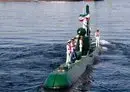
![Two Ghadir‑class mini submarines sit idle at the port during a ceremony introducing the vessels. [Vahid Reza Alaei/AFP]](/ssc_fa/images/2026/05/07/55926-_121__ghadir_class_mini_submarines-600_384.webp)
The Islamic Republic is promoting its latest mini submarine as a strategic breakthrough, asserting it could evade US surveillance.
That claim collapses under scrutiny, as extensive self‑imposed constraints and documented tactical miscalculations severely undermine the vessel's real capabilities.
Heavy mining in the Strait of Hormuz has created hazardous, unpredictable operating zones that now threaten the Islamic Republic's own naval movements.
Operational reports from April 2026 indicate the Islamic Republic has lost track of numerous mines due to shifting regional currents.
This confusion forces its submarines into narrow, predictable transit corridors that US intelligence can identify and monitor with precision.
Once these bottlenecked routes are mapped, the mini submarines are extremely vulnerable because they have nowhere else to maneuver safely.
Their dependence on confined coastal zones undermines any attempt to project strength beyond shallow territorial waters.
The Ghadir‑class submarines suffer from substantial endurance limits that prevent sustained operations in deep, open waters.
Their short range, minimal battery capacity and lightweight construction make long‑distance patrols physically and structurally unsustainable.
In deeper seas, the acoustic environment becomes far less forgiving for small diesel platforms attempting to remain undetected.
Without the cluttered background noise of the shallow Gulf, their engines and mechanical signatures become easy targets for US sensors.
Advanced towed‑array sonar systems can detect these submarines at extended ranges once they leave coastal masking conditions behind.
This stark disadvantage illustrates a significant tactical misjudgment by commanders who directed operations beyond the subs' intended design envelopes.
Sending these vessels into deep water displays an alarming willingness to risk crews in situations offering virtually no chance of survival.
Meanwhile, US air and sea assets maintain broad situational awareness across the Gulf of Oman and the northern Indian Ocean.
Aircraft like the P‑8A Poseidon can monitor immense patrol areas, exposing any short‑range submarine attempting to close the distance undetected.
A single Mk 48 torpedo from a US attack submarine would decisively disable or destroy a Ghadir‑class vessel within seconds.
Taken together, disinformation, navigational hazards, and strategic miscalculations render the showcased mini-submarine essentially obsolete against US naval power.