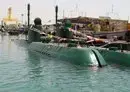
![Members of the Islamic Republic's Navy stand on a Ghadir-class submarine in the southern port of Bandar Abbas, Iran. November 29, 2018. [Press TV]](/ssc_fa/images/2026/05/06/55925-ghadir-600_384.webp)
When the Islamic Republic deploys its Ghadir‑class midget near the Strait of Hormuz, state media portrays the action as credible deterrence.
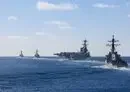
In practice, those 29‑meter vessels enter a layered anti‑submarine warfare network that the US Navy has spent decades refining.
US naval planners argue the Ghadir‑class primarily serves as a platform that challenges ASW systems rather than confronting carrier strike groups directly.
A hunter the Ghadir cannot hide from
At the core of US airborne ASW capability is the AN/AQS‑22 Airborne Low Frequency Sonar, a highly advanced dipping system on the MH‑60R Seahawk.
It lowers a sensor directly into the water to actively search for submerged targets with precision and consistent detection performance.
Unlike hull-mounted bow sonars on destroyers, this system penetrates deeper into the acoustic layers where miniature submarines often attempt to hide near the seabed.
The AN/AQS-22 remains the only operational dipping sonar with multi-frequency functionality, allowing it to adapt to environmental conditions while maintaining a rapid search rate.
Once a contact is localized, the Seahawk immediately transitions to prosecution and begins preparing its onboard weapons for engagement.
The ALFS and its processing suite integrate closely with the Mk 54 lightweight torpedo, giving the MH-60R a full detect-to-engage ASW capability.
This capability allows the aircraft to independently locate and destroy submarines without relying on external support or coordination.
If a Ghadir surfaces or operates at shallow depth, the Seahawk can also employ AGM‑114 Hellfire missiles, leaving the crew without any safe operating band.
The MH-60R's APS-153 Multi-Mode Radar is engineered to detect small, fleeting targets, including a submarine's periscope or snorkel during brief exposures.
This capability denies the Ghadir class the access it requires to recharge its batteries, severely limiting its operational endurance in contested waters.
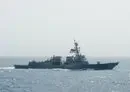
Variable-depth sonar towed beneath thermal layers closes the final detection gap that hull‑mounted destroyer sonars cannot reach in shallow environments.
This system provides the broader ASW network with complete acoustic coverage of the Gulf's thermocline-layered waters, eliminating hiding places for miniature submarines.
Should the Islamic Republic attack a US carrier strike group, it could trigger a retaliatory campaign that the regime's forces would struggle to withstand.
The Ghadir fleet is a propaganda tool; against a networked ASW force, it is also a losing proposition.