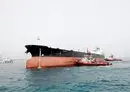
![An oil tanker was unloading imported crude oil at the crude oil terminal of Qingdao Port in Qingdao City, Shandong Province, China on May 13, 2026. [AFP]](/ssc_fa/images/2026/05/20/56106-_135__oil_tanker_in_china-600_384.webp)
The US is escalating its "Economic Fury" campaign, yet new sanctions struggle as Beijing expands financial shielding that protects key partners from American pressure.
The arrangement offers the Islamic Republic and Russia a neutral currency alternative that avoids the reach of a weaponized dollar.
China's support is not driven by generosity or strategic brilliance, but by calculated self‑interest.
A calculated self-interest to extract resources from struggling partners while insulating its own firms from Western scrutiny.
The Islamic Republic has sent billions in oil to China, revenue diverted from its collapsing economy and instead used to procure weapons and strengthen proxies.
A recent satellite agreement reportedly valued at RMB 250 million illustrates how this system works.
By denominating the deal in Renminbi (RMB), the transaction bypasses dollar‑clearing systems, avoiding the Western SWIFT network, reducing Treasury visibility and complicating sanctions enforcement efforts.
The settlement occurs entirely in RMB, meaning the buyer pays and the seller receives funds in Chinese currency rather than dollars.
More than 80 percent of the Islamic Republic's oil trade with China is now settled in Renminbi.
This gives Beijing a steady supply of discounted crude and provides the Islamic Revolutionary Guard Corps (IRGC) with a financial lifeline.
The price of each barrel is fixed in RMB units, reinforcing China's role as the unit of account for these transactions.
This shift offers sanctioned states a narrow but durable lifeline, allowing access to critical technology and energy markets without exposing transactions to US jurisdiction.
For Beijing, the arrangement strengthens its position as a global financial alternative while keeping the Islamic Republic dependent and economically constrained.
The consequences inside Iran are severe. The outflow of oil to China has not stabilized the economy but accelerated its deterioration.
This is contributing to extreme depreciation of the Iranian rial and deepening public hardship.
The IRGC's focus on external operations and procurement has diverted resources away from domestic needs, leaving the broader economy brittle and increasingly isolated.
As Washington expands its sanctions pressure, the axis of evasion anchored in Beijing continues to blunt the full impact.
The challenge is not China's sophistication but its willingness to provide financial cover to those whose economies are already buckling under their own mismanagement.